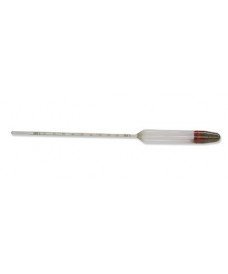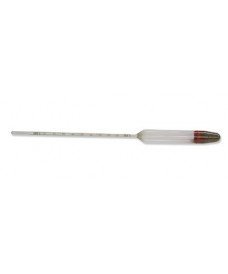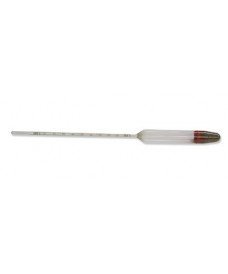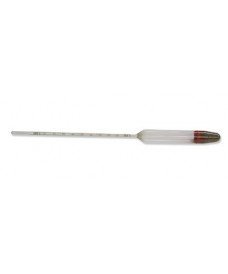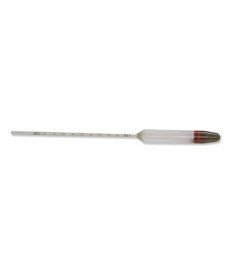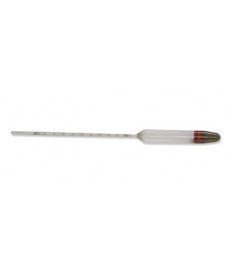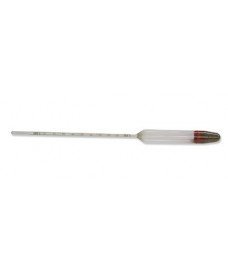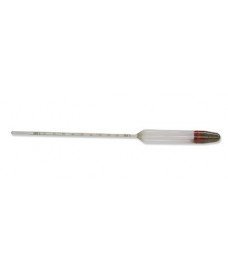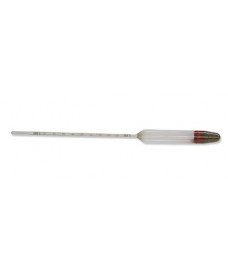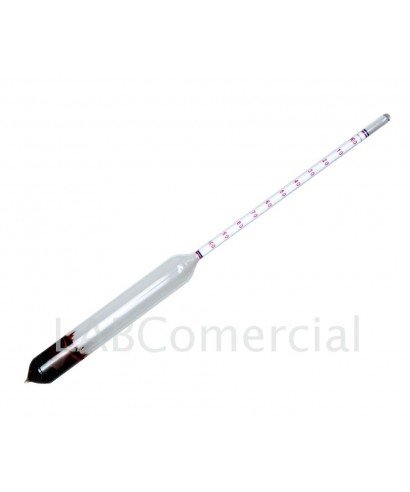
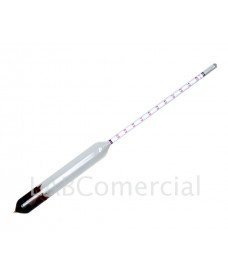
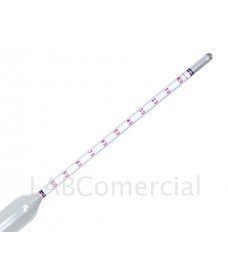
Graduated hydrometers from 1,000 to1,100 kg/m³ with 1 kg/m³ divisions

Hydrometer 1,000-1,100 graduated 1/1

Code

Graduated glass hydrometer from 1,000 kg/m³ to 1,100 kg/m³ with divisions of 1

Graduated on kg/m³ density scale
Calibrated at 20 °C
Length 310 mm

€13.58 tax incl.
€11.22 Tax excl.
Spain 21% VAT; The final tax applicable may vary according to the country of destination.

Data sheet

Product Type
Hydrometer, kg/m³
Material
Soda–Lime–Silica Glass
Scala Density SG
1,000-1,100 kg/m³
Accuracy Min. Div. SG
1 kg/m³
Length - Long
310 mm
Calibration
Calibrated at 20 °C with distilled water (without certificate)
Category
Hydrometers / Aerometers
    Asked by: jose
    Date: 2025-09-01 08:36:33
    Hello, good morning. I would like to find out the Baumé degrees of a liquid (calcium polysulphide). Which aerometer would you recommend, and could you explain how it works? Thank yo

    Good morning:
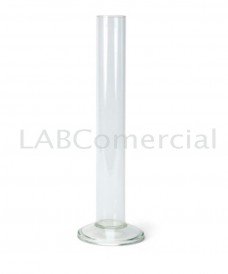
    In response to your enquiry, we need to know the Baumé scale of this chemical product. Once confirmed, we will be able to indicate the correct reference you should purchase together with the glass measuring cylinder, which is 524.017.

    To use a hydrometer (aerometer for liquids) in a cylinder:

    1. Prepare the materials:
      • Clean the glass cylinder and rinse it with a small amount of the liquid to be measured to avoid contamination.
      • Select a hydrometer suitable for the expected density; if it sinks too much, it is not the correct range.
    2. Fill the cylinder:
      • Pour the liquid into the cylinder without overfilling it, avoiding overflow when inserting the hydrometer.
      • Ensure the product temperature is correct; otherwise, use equivalence tables.
    3. Insert the hydrometer:
      • Hold it from the top and gently introduce it into the liquid.
      • Spin it slightly with your fingers so it does not stick to the cylinder walls and can float freely.
    4. Allow stabilisation:
      • Let the hydrometer float freely and vertically without touching the bottom or the sides of the cylinder.
    5. Take the reading:
      • Position your eyes at the liquid level and observe the graduated scale.
      • Read at the bottom of the meniscus (the curve formed by the liquid surface). This point on the scale corresponds to the relative density of the liquid.

    Is this answer helpful to you? Valoration: 0 / 0

    Asked by: Hugo
    Date: 2025-09-03 22:59:17
    I need a device to measure the alcohol content of grapes. What would you recommend? Thank you.

    Which instrument is used to measure grape must?

    Grapes do not have "degrees" per se; what is measured is the sugar content in the must, which helps estimate probable alcohol content. We recommend two instruments:

    • Handheld refractometer with 3 scales – Ref. 720.5150
      View product
      Measures °Brix, Baumé and probable alcohol. Requires only 2–3 drops.
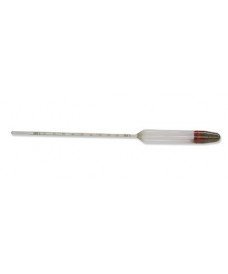
    • Mustimeter (glass hydrometer) with 2 scales – Ref. 414.
      View product
      Used with a 250 ml glass cylinder.
      Recommended cylinder

    Both options are reliable, but the refractometer is more practical and faster.

    Is this answer helpful to you? Valoration: 0 / 0